Table of Contents
Supported targets
A Zephyr board selects the SoC, devices and flash runner. A K-FSW target adds the application configuration and tool defaults in config/targets/<target>.env; for example rpi_pico_w maps to rpi_pico/rp2040/w.
| Target | Zephyr board | Default composition | Tested |
|---|---|---|---|
linux | native_sim/native/64 | Full reference composition, including the journal, HK store, command retry and FWU | Software tests in CI |
nucleo_l496zg | nucleo_l496zg | Full MCU composition; shell on the ST-LINK, CSP on USART3 | CI build; boot, storage, UART/KISS, CSP, remote parameters and FTP on the bench |
frdm_k64f | frdm_k64f/mk64f12 | Shell only until tag 2.0 | Boot and shell on the board |
rpi_pico_w | rpi_pico/rp2040/w | Core services; USB shell, UART0 CSP, persistent LittleFS | Software build only; service HIL not run |
The board files are app/boards/<board>.conf and .overlay. Only linux and nucleo_l496zg are built in CI.
Required board transports
Every supported hardware board must carry CSP over both CAN and UART/KISS, and board acceptance checks both links on the normal image and, where there is one, the Golden image. Each composition defines its routes explicitly; there is no automatic failover.
| Board | Transport status | Remaining work |
|---|---|---|
| NUCLEO-L496ZG | UART/KISS in the board configuration; CAN from nucleo-can.conf. The update images enable both. | Make both links part of the standard composition and acceptance matrix. |
| NUCLEO-F746ZG | The A and Golden images built by tools/f746-proof.sh use CAN1 PD0/PD1 at 500 kbit/s and UART/KISS on USART6, route 1 KISS,0/0 CAN. CAN needs an external transceiver. | Verify both links on A and Golden. Not run on hardware. |
| Pico W | UART/KISS only. The RP2040 has no CAN controller, so a transceiver alone is not enough. | Choose an external CAN controller with a Zephyr driver, record its wiring, check RAM and test both links. |
| FRDM-K64F | Shell only, although the SoC has a CAN peripheral. | CAN and a UART/KISS link in the 2.0 work. |
Identifying a unit
Every target reports its chip's unique ID: as unit= in the boot marker, in status and version, and as hw_id in the board table. It is 96 bits on the STM32L496, 128 on the Kinetis K64 and 64 on the RP2040. The CSP model is the board target, so csp ident names the hardware too.
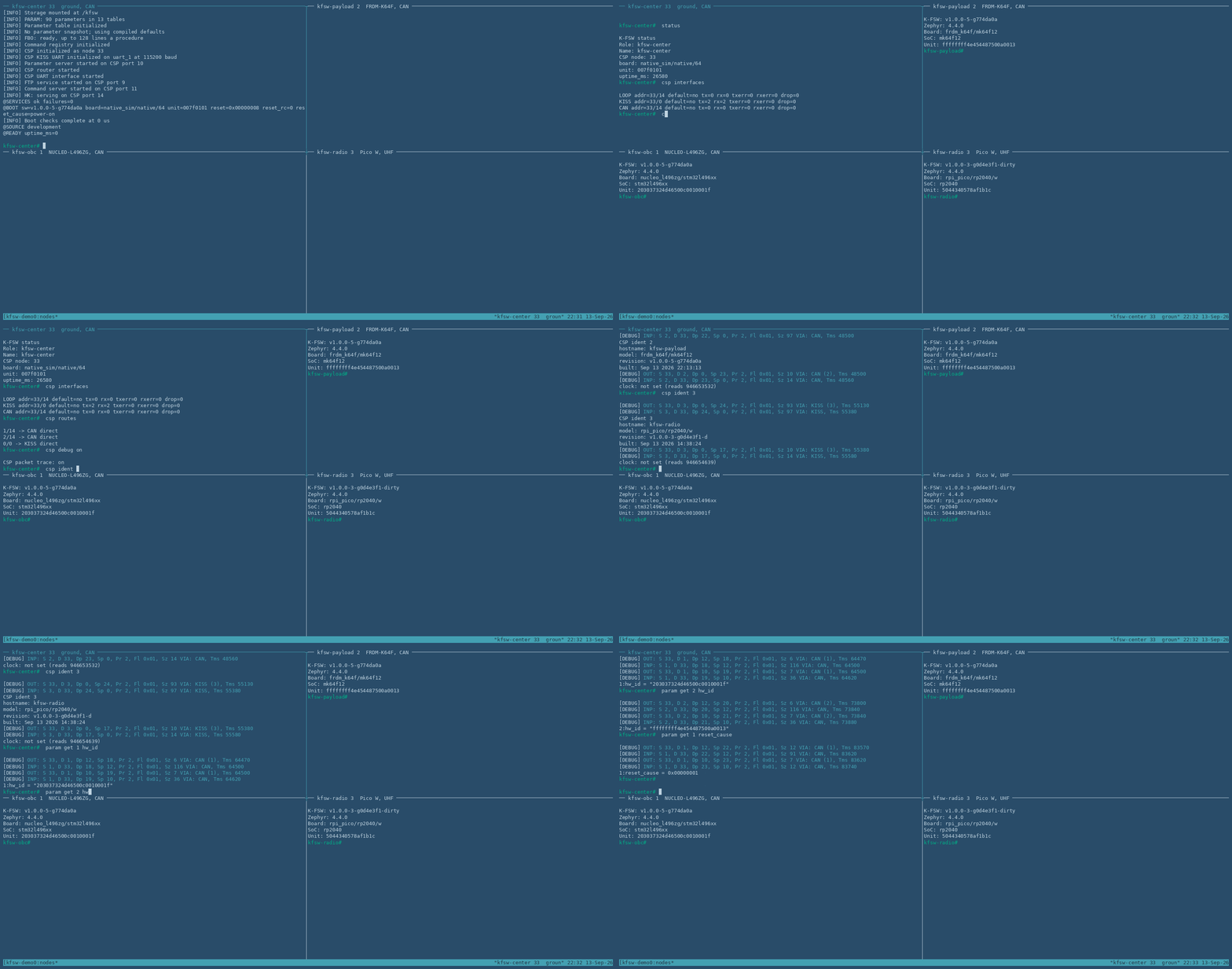
The FRDM and the Pico in this recording run bench configurations with CSP on CAN and behind a UHF radio, not their current default images.
KFSW-Linux
KFSW-Linux is the application built for Zephyr's 64-bit native simulator. It compiles the same sources as the NUCLEO build, on simulated devices. Use it for software tests; measure timing, interrupt load and flash behaviour on the MCU.
The executable is build/linux/zephyr/zephyr.exe, and the runner gives it build/linux/kfsw-storage.bin as flash; tests use their own flash files. The shell uses stdin/stdout. A line such as
is the CSP UART, not the console.
CI builds the target and a composition without CSP. Twister runs the unit tests, the integration and Robot tests start one or two full processes, and Valgrind checks a normal boot and one with a corrupted snapshot. tests/config/linux-node2.conf configures the second test node.
NUCLEO-L496ZG
The NUCLEO image carries storage, local and remote parameters, persistence, CSP over UART/KISS, FTP, commands, events, housekeeping and beacons, log history and remote logs, last words, remote execution, file based operations, limits, the resource monitor, the ground watchdog, the hardware watchdog and health. Flash is split into a 960 KiB application partition and a 64 KiB LittleFS partition.
| Connection | Hardware | Use |
|---|---|---|
| Debug console | ST-LINK virtual COM, LPUART1 | Shell, logs and boot markers |
| CSP link | USART3, PD8 TX and PD9 RX | 115200 8N1 KISS |
CSP reception is interrupt driven. The NUCLEO is node 2 and sends traffic for every other node to the KISS interface.
Button and LED example
button_test is not in the default image. Build it with:
The overlay maps the USER button and the green, blue and red LEDs (LD1 to LD3) to the module's chosen properties, so the pins stay in devicetree. The button is debounced for 30 ms on the system workqueue, and its values are in table 67. The manual test is in tests/hil/button-test/.
Wall clock
The default image keeps wall time in the RTC (CONFIG_RTC and the kfsw,rtc chosen node), and csp clock set <seconds> sets it. The RTC counter is not cleared by a reset. The board devicetree clocks the RTC from the LSI. In a composition without an RTC, setting and reading the wall clock returns -ENOTSUP.
config/profiles/nucleo-clock.conf and nucleo-clock.overlay add Zephyr's counter and POSIX clock APIs on top; no test or tool uses them.
Last words
The image keeps a short note across a restart and watches the supply voltage, so a node can report why it went down. param get last_reason, last_detail and last_uptime_ms read it, and the note is cleared once reported.
MCUboot
The bootloader is not in the default image. Build it with sysbuild:
nucleo-mcuboot.conf turns the bootloader on and the two overlays lay out the flash for it.
| Partition | Address | Size |
|---|---|---|
boot_partition | 0x000000 | 64 KiB |
slot0_partition | 0x010000 | 352 KiB |
slot1_partition | 0x068000 | 352 KiB |
kfsw_golden_partition | 0x0C0000 | 188 KiB, recovery image |
kfsw_boot_budget_partition | 0x0EF000 | 4 KiB, early boot budget |
kfsw_storage_partition | 0x0F0000 | 64 KiB |
The bootloader and the application use the same flash map overlay. The storage partition stays at 0xF0000, so an existing filesystem survives the move to MCUboot; the rollback test checks that a stored value is still there after every swap.
The golden partition holds the recovery image built by tools/golden.sh from config/profiles/nucleo-golden.conf: CSP, parameters, the command server and both update routes, and nothing else. It is signed and linked like any other image. The bootloader only boots the slots, so installing it means copying it into the secondary slot and swapping. golden_install does that on command, and the boot service does it on its own once boot_attempts_left reaches zero.
Signing
The signing key is private and kept outside the repository. With KFSW_MCUBOOT_KEY the build puts its public key in the bootloader and signs the application. tools/build.sh refuses a sysbuild build without it. MCUboot's development key, which anyone can sign with, is used only when KFSW_MCUBOOT_KEY names it, as CI does; the rollback test checks that a board built with the real key rejects an image signed with it.
Bootloader settings go in app/sysbuild.conf as SB_CONFIG_* symbols. Sysbuild overrides settings placed in a fragment on the bootloader image.
Watchdog
The hardware watchdog is in the default image, with an 8000 ms timeout, armed at the top of main(), before the flash and filesystem work. Arming it at start covers a hang before the first ground contact, and the STM32 independent watchdog cannot be disarmed once started. The overlay binds it through kfsw,watchdog, because the board's watchdog0 alias is the window watchdog, which resets when fed too early and has a much shorter timeout.
In the MCUboot profile the bootloader has already started the same watchdog with a 30 s timeout (app/sysbuild/mcuboot.conf), so a hang in driver initialisation, or an image that never reaches main(), still resets the board and an unconfirmed trial is reverted. nucleo-mcuboot-flash.overlay points the bootloader's watchdog0 at the independent watchdog for this. Every application booted by this bootloader must arm and feed the watchdog within 30 s. That is close to the ceiling: the IWDG counts a 12-bit reload at LSI/256, so it reaches 32.768 s and no more.
Build, flash and console
Use a stable serial path if the default device is wrong:
To debug, start the server in one terminal and the client in another:
The scripts build first when the ELF is missing.
Hardware tests
The boot test checks that the ST-LINK is there, builds, flashes, captures the console and waits for @BOOT and @READY. The UART/KISS test adds an FTDI cable and a KFSW-Linux peer, and checks ping, comms uart test, storage, a remote parameter, 4 KiB and 16 KiB transfers and the KISS counters; see CSP and links. The radio bench profile, nucleo-testbench.conf and its overlay, sets USART3 to 57600 baud for the Holybro radio.
FRDM-K64F
The frdm_k64f target maps to frdm_k64f/mk64f12 and uses the OpenSDA serial console and the OpenOCD runner. CSP, parameters, persistence, FTP, storage and the filesystem are disabled until tag 2.0.
The test builds, flashes, waits for kfsw:~$ and runs status, version and help.
NUCLEO-F746ZG Golden prototype
The default F746 composition (app/boards/nucleo_f746zg.conf) is a second CSP node for the CAN bench, without storage. The opt-in recovery compositions use MCUboot's firmware loader mode with this map (f746-recovery-flash.overlay):
| Region | Flash offset range, half open | Size |
|---|---|---|
| MCUboot | [0x00000, 0x10000) | 64 KiB |
Permanent executable Golden (image-1) | [0x10000, 0x40000) | 192 KiB |
Running A (image-0) | [0x40000, 0x80000) | 256 KiB |
File region (storage) | [0x80000, 0x100000) | 512 KiB |
Flash is mapped at 0x08000000. Each image links at its own region, MCUboot header included. MCUboot calls Golden the secondary image internally, but there is no B update slot and no rollback to a previous A.
| Profile | Adds |
|---|---|
f746-uart.conf, f746-can.conf, f746-minimal.conf | Image A: node 3, peer 1, both CSP links, PARAM and the command service, no shell, no storage |
f746-golden.conf | Golden on top of A's profiles: CSP and PARAM, commands and shell off |
f746-golden-upload.conf | The recovery writer: FWU lite over CSP writes A from Golden, with the command service back for the reboot |
f746-zms-storage.conf and .overlay | LittleFS over the ZMS disk in the file region, with parameter persistence and FTP, for image A |
UART/KISS runs on USART6, PG14 TX and PG9 RX, at 115200 8N1; USART3 is the ST-LINK console. CAN is the default route.
f746-mcuboot.conf validates both images on every boot (BOOT_VALIDATE_SLOT0, which the pinned boot/zephyr/firmware_loader.c applies to both), falls back to Golden when A is invalid (BOOT_FIRMWARE_LOADER_NO_APPLICATION) and enters Golden when the user button, PC13 active high, is held at reset (mcuboot-button0). If Golden is invalid on a forced entry, the bootloader still tries A. A correctly signed A that hangs is not detected by this policy. Firmware update describes the upload into A.
tools/f746-proof.sh builds A and Golden without the upload and storage profiles and checks them offline. From the k-fsw directory:
The tool has no flash subcommand. The checker reads the generated devicetrees, Kconfig, ELF files and signed binaries. It checks the shared map, entry bounds, signed lengths and headers, compares the SHA-256 TLV (type 0x10) with the hash of the MCUboot header and payload, verifies the ECDSA signatures against the generated public key, and rejects wrong modes, missing validation, overlap and oversized images. check needs Python's cryptography package and the pinned Zephyr devicetree sources; only use edt.pickle files generated locally.
tools/ci/golden.py, part of tools/ci/all.sh, builds Golden with the upload profile and checks that it fits slot1_partition. tools/ci/quality.sh runs the synthetic f746-proof-test.py cases, and tools/ci/all.sh --suite board runs the real offline build when a signing key is readable. No test or tool builds the ZMS storage profile.
None of this has run on an F746. Before physical trials it still needs valid-A selection, invalid-A fallback, button entry, invalid-Golden and wrong-key refusal evidence, then interrupted upload, bounded erase and write, filesystem durability and usable capacity. Do not enable the L4 swap path on this map: its erase and trailer region would overlap the running A.
Raspberry Pi Pico W
The rpi_pico_w default image carries local and CSP parameters with persistence, table files, FTP, the command service with retry, events and the journal, HK collection, sample files and beacons, log history and remote logs, last words, remote execution, file based operations, limits, the resource monitor, the ground watchdog, the hardware watchdog and health. Beacons stay off until a report has an interval.
The USB CDC ACM console is separate from CSP, and the shell waits for DTR. UART0 uses the board's uart0_default pinctrl at 115200 8N1 without flow control. The Pico is CSP 2 node 3, with peer 1 and route 0/0 KISS.
| Connection | Pico W header | Peer connection |
|---|---|---|
| CSP UART0 TX | GP0, physical pin 1 | 3.3 V UART RX |
| CSP UART0 RX | GP1, physical pin 2 | 3.3 V UART TX |
| Common ground | GND, physical pin 3 | UART GND |
| Debug shell | USB CDC ACM | Host USB terminal with DTR |
Flash and RAM
The board has 2 MiB of external XIP flash at 0x10000000. Offsets are relative to that address; ranges are half open.
| Region | Offset range | Size |
|---|---|---|
| RP2040 boot2 | [0x000000, 0x000100) | 256 B |
Application code_partition | [0x000100, 0x1c0000) | 0x1bff00 B (1,834,752 B) |
| Persistent LittleFS | [0x1c0000, 0x200000) | 256 KiB |
The overlay shrinks the board's code partition and leaves boot2 intact. CONFIG_USE_DT_CODE_PARTITION=y makes Zephyr link the application at offset 0x100 with a load size of 0x1bff00. The storage partition is aligned to the 4096 B erase sectors. Zephyr's RP2040 flash driver runs the Pico SDK flash routines with interrupts locked, so a flash write can delay UART reception and watchdog feeding; nobody has measured how much.
The platform mounts the volume at /kfsw: erased media is formatted on first mount, existing media is mounted as it is, and corrupt media that is not erased is refused. Parameter snapshots, the journal, HK files and FTP share the 256 KiB.
/kfsw/tmp is a 32 x 512 B RAM disk, formatted at every boot. Its 16 KiB comes out of the 264 KiB SRAM, which also holds the main stack (2048 B), the shell stack (3072 B), the second shell instance remote execution uses (3072 B) and its server stack (3072 B). Service stacks and table capacities keep their defaults. Static RAM is close to full in this composition: check the RAM line of the linker's memory report, and ram_report, before adding anything.
The watchdog has an 8000 ms timeout and is armed at the top of main(), as on the NUCLEO; health checks every 500 ms with a 4000 ms application deadline. 8000 ms is below the RP2040 driver's maximum of about 8388 ms after erratum RP2040-E1. The RP2040 RTC backs the CSP clock; whether it keeps time across a reset or power loss has not been checked.
Scope and verification
MCUboot, FWU, golden recovery and scrub are not available: the layout reserves no bootloader, secondary or golden partition. The STM32 supply-voltage last words detector does not exist on the RP2040. CAN, radio crypto, Wi-Fi and the example device modules are not composed. Float parameters are off, as on the reference boards.
The only physical evidence is USB shell bring-up. The service composition has been built but not run on a Pico. Physical acceptance needs:
- USB shell and boot markers.
- Storage write, reset and read; parameter save, reset and restore.
- CSP ping in both directions and the effective routes; remote PARAM.
- FTP integrity and full-volume refusal; HK and log reads.
- Remote execution allowlist refusal; FBO and limits actions.
- Watchdog recovery.
- UART error and drop counters recorded while flash is being written.
- A corrupt, non-erased filesystem left unformatted.
To build it with its reports, from the k-fsw directory:
tests/hil/shell-smoke.sh rpi_pico_w checks shell bring-up only, through the UF2 runner and a stable USB serial path; with KFSW_FLASH=0 it skips flashing for a UF2 copied by hand. The NUCLEO service tests have no Pico flash or USB console support.
Shell test and target files
tests/hil/shell-smoke.sh has the test steps, and each target's .env file has the board details:
A new shell target only needs its own .env file, unless its hardware behaves differently.
Adding a target
- Use a Zephyr board, upstream or in the project.
- Add
config/targets/<name>.envwith the board and tool settings. - Add
app/boards/<board>.confwith the default composition. - Add an overlay if K-FSW has to choose a UART, storage partition or console.
- Build it from clean.
- Add software tests for any new shared code.
- Add a hardware test for the services it enables.
Moving the NUCLEO configuration to another board also means checking the storage layout, UART wiring, flash runner, console and memory sizes.